
Contents [ Hide ]
- 1 Best Psychedelic Artworks: Iconic Paintings & Artists
- 2 What Makes Art Psychedelic?
- 3 Iconic Psychedelic Artists and Their Key Works
- 3.1 Alex Grey – Theologue and the Sacred Mirrors
- 3.2 Understanding the Sacred Mirrors Series
- 3.3 Pablo Amaringo – Huasi Yachana and Ayahuasca Visions
- 3.4 The Cultural Importance of Amaringo’s Work
- 3.5 Amanda Sage – Orphic Awakening and Visionary Portraiture
- 3.6 Salvador Dalí – The Hallucinogenic Toreador
- 3.7 Other Notable Contributors
- 4 Comparing Key Psychedelic Artworks
- 5 Why These Works Continue to Matter
- 6 How to Approach Psychedelic Art as a Viewer
- 7 Final Thoughts
Best Psychedelic Artworks: Iconic Paintings & Artists
Psychedelic artworks are often reduced to “trippy colors,” yet the best examples go far deeper. They alter perception, challenge ordinary ways of seeing, and attempt to make visible experiences that words struggle to describe. From classical surrealism to modern visionary painting, the strongest psychedelic artworks invite viewers to step outside everyday reality for a moment and look again.
This guide explores what defines psychedelic art, highlights iconic paintings and the artists behind them, and explains why these works continue to resonate. Whether you are new to the genre or already familiar with names like Alex Grey and Pablo Amaringo, the goal is to give you a clear, grounded overview of the best psychedelic artworks and the ideas that shape them.
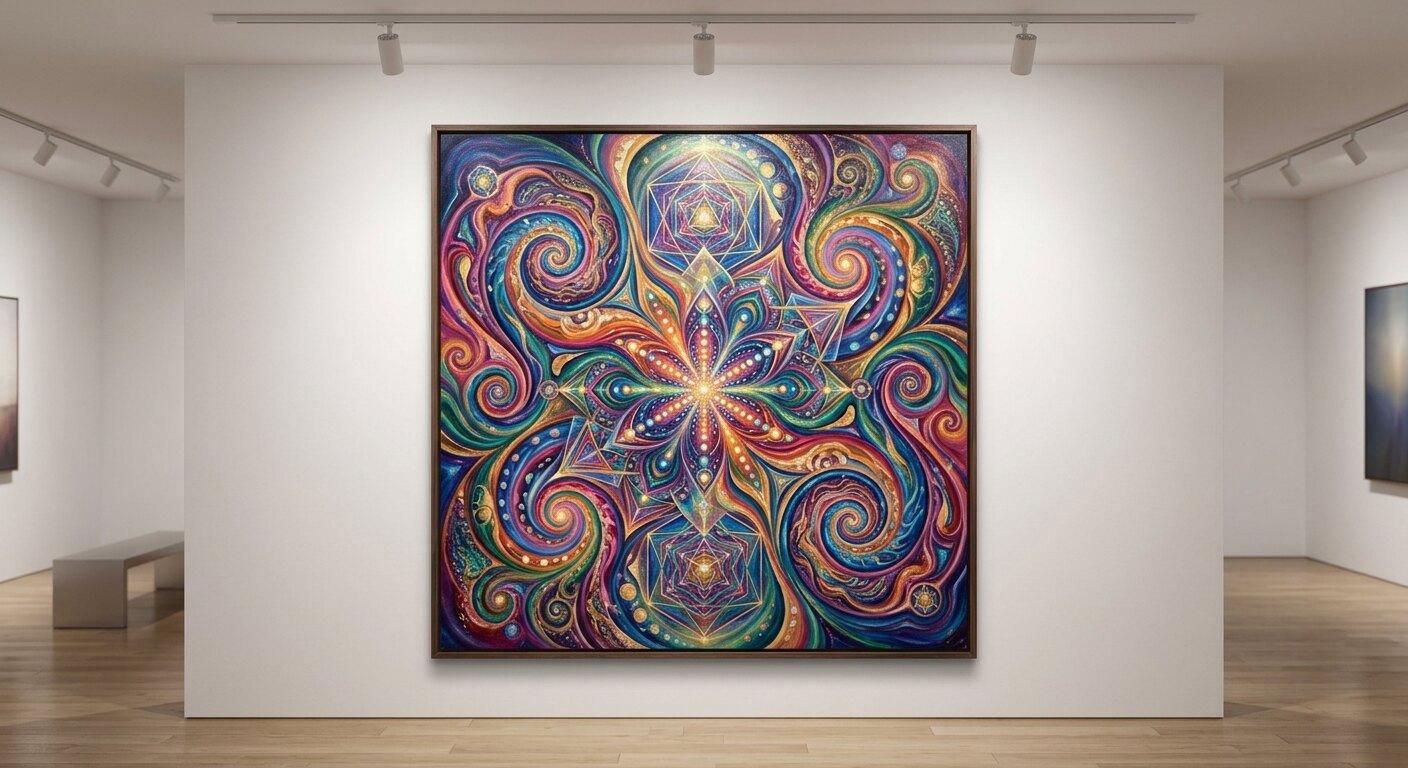
Why Psychedelic Art Continues to Attract New Audiences
Interest in psychedelic artworks has grown steadily in recent years. Online galleries, social media, and renewed public conversation about consciousness have introduced these images to people who may never have visited a traditional museum. The combination of striking visuals and deeper philosophical questions makes the genre accessible while still rewarding careful attention.
What Makes Art Psychedelic?
Psychedelic art, sometimes called psychedelia or visionary art, is visual work inspired by or meant to evoke altered states of consciousness. The term “psychedelic” itself was coined in the 1950s and means “mind-manifesting.” In artistic practice it usually refers to paintings, drawings and related media that try to represent the sensory, emotional or spiritual intensity reported during profound inner experiences.
Core Visual Characteristics
While no single formula exists, many of the best psychedelic artworks share recognizable traits:
- Intense, high-contrast or luminous color
- Fractal, kaleidoscopic or repeating patterns
- Distorted space, depth or scale
- Morphing forms and hybrid imagery
- Geometric grids combined with organic or anatomical detail
- A sense of energy, light or transparency moving through the body or landscape
These elements do not automatically make a work “psychedelic.” Context, intention and the feeling the piece produces matter just as much. A classical painting can feel psychedelic if it successfully shifts the viewer’s sense of reality; a brightly colored design can feel flat if it lacks depth or emotional charge.
Psychedelic Art and Culture
Psychedelic art sits at the intersection of personal vision, cultural history and spiritual inquiry. Indigenous traditions, especially those involving plant medicines in the Amazon, have long produced complex visual languages for inner experience. In the twentieth century, Western artists began translating similar territory into oil, acrylic and mixed media after encounters with LSD, psilocybin and related compounds. The result is a body of work that ranges from intimate visionary portraits to large-scale cosmological scenes.
For readers interested in the substances that have historically inspired much of this art, our guides on what is psilocybin and what magic mushrooms do to the mind and body provide useful scientific and historical background.

The Role of Personal Experience in Creating Psychedelic Art
Many artists who produce psychedelic artworks describe their process as an attempt to translate inner states into visible form. Some work directly from memory of specific experiences. Others use meditation, sustained observation, or formal experimentation with color and geometry to reach similar territory. The finished painting becomes a bridge between the private vision of the artist and the shared visual experience of the viewer.
Iconic Psychedelic Artists and Their Key Works
Several artists have become central reference points for anyone exploring the best psychedelic artworks. Their approaches differ, yet each has produced images that continue to circulate widely and influence newer creators.
Alex Grey – Theologue and the Sacred Mirrors
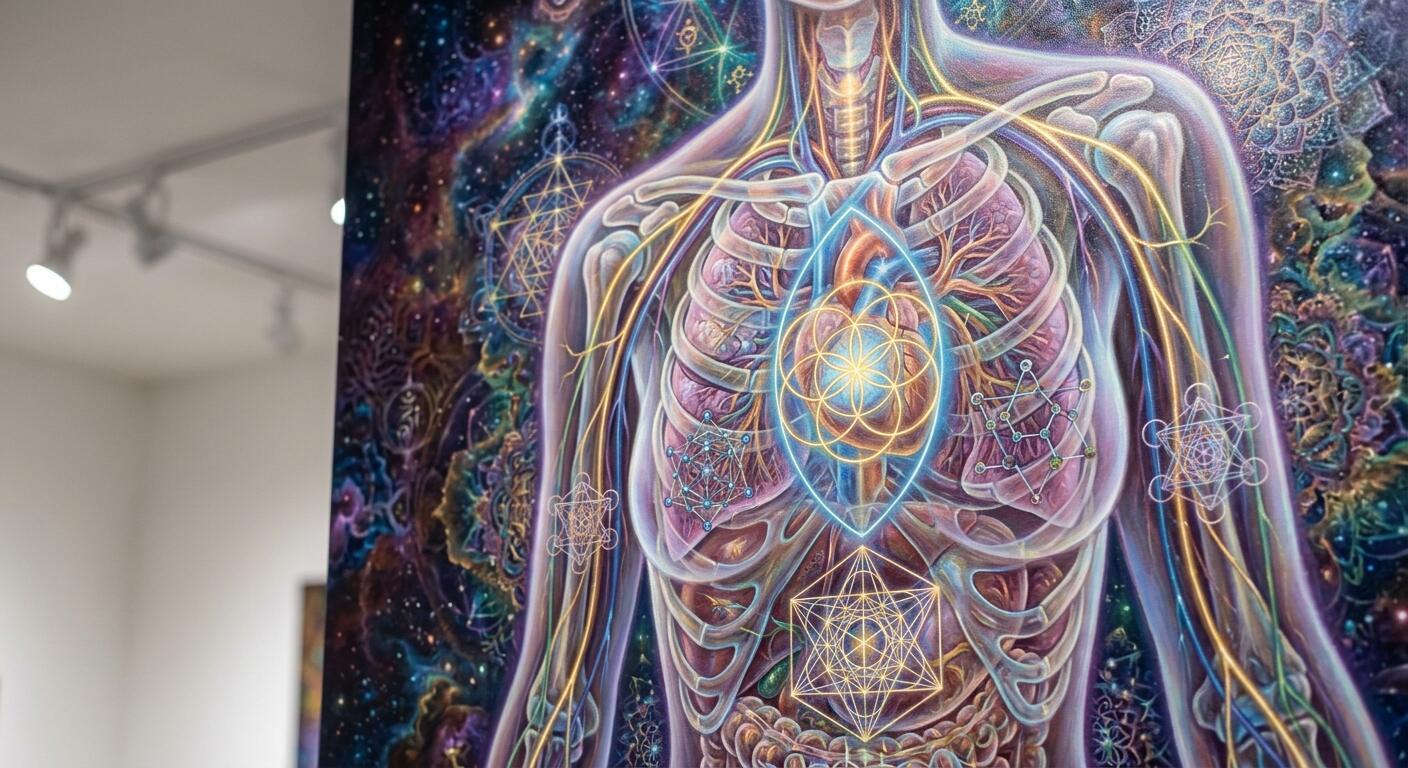
Alex Grey is one of the most recognized contemporary visionary painters. His work frequently depicts the human body as both anatomical and luminous, with energy systems, chakras and geometric frameworks made visible. Paintings such as Theologue attempt to show the meeting of individual consciousness with a larger field of awareness. Grey has openly discussed how early psychedelic experiences redirected his artistic focus toward higher states of consciousness and the interconnection of body, mind and spirit.
His long-running Sacred Mirrors series presents progressive layers of the human form—from physical systems to subtle energetic and archetypal dimensions. The combination of precise anatomical knowledge and spiritual symbolism has made these works especially influential among both art audiences and people interested in contemplative practice.
Understanding the Sacred Mirrors Series
The Sacred Mirrors series is often discussed as a progressive journey through layers of human existence. Early panels focus on the physical body with medical accuracy. Later panels introduce energetic, archetypal and cosmic dimensions. Viewers frequently report that the sequence encourages a sense of movement from the personal to the universal.
Pablo Amaringo – Huasi Yachana and Ayahuasca Visions
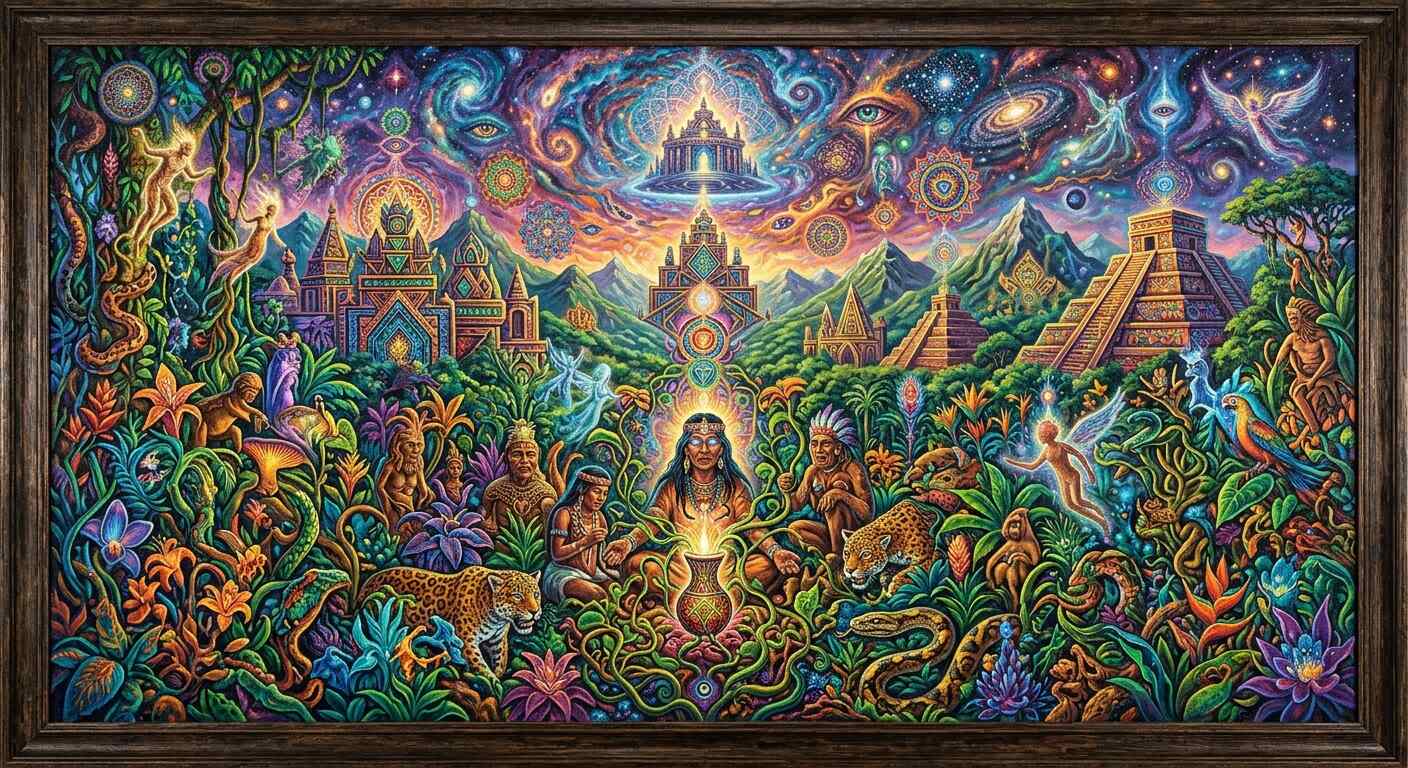
Pablo Amaringo (1938–2009) was a Peruvian artist and former ayahuasquero whose paintings remain among the most detailed visual records of Amazonian visionary experience. Works such as Huasi Yachana fill the canvas with temples, spirits, animals, celestial forms and intricate plant motifs. Amaringo painted from direct recollection of his journeys and later founded an art school that helped spread this visual language far beyond the Amazon.
His paintings are dense, colorful and narrative. They function both as personal documents and as invitations for viewers to consider the intelligence and complexity of the forest and its traditional knowledge systems. Amaringo’s influence continues through younger Amazonian painters and through books that reproduce his major works.
The Cultural Importance of Amaringo’s Work
Amaringo’s paintings helped introduce Amazonian visionary imagery to international audiences. They also supported the documentation and preservation of traditional knowledge at a time when many cultural practices faced external pressures. His school trained a generation of local artists who continue to develop the style today.
Amanda Sage – Orphic Awakening and Visionary Portraiture
Amanda Sage works in a luminous, layered style that often combines portraiture with concentric patterns, geometric structures and symbolic color. Paintings such as Orphic Awakening explore themes of self-awareness, transformation and connection to larger living systems. Her technique of glazing and careful color modulation creates a glowing quality that many viewers find immersive.
Sage’s work sits comfortably alongside Grey’s in the contemporary visionary tradition while maintaining a distinct voice focused on awakening and the relationship between individual and cosmos.
Salvador Dalí – The Hallucinogenic Toreador
Although Salvador Dalí is primarily associated with surrealism, certain late works sit at the edge of psychedelic imagery. The Hallucinogenic Toreador (1968–1970) is a large, complex composition that layers classical references, optical effects and shifting forms. Dalí claimed he did not need external substances because his imagination already operated in that territory. Regardless of method, the painting remains one of the most ambitious attempts to sustain a multi-layered, perception-bending visual experience on a monumental scale.
Other Notable Contributors
Martin Sharp’s graphic work, including images associated with Jimi Hendrix, helped define the visual language of 1960s psychedelic culture through bold color, distorted lettering and energetic composition. Jonathan Solter’s more recent fractal-influenced pieces continue the exploration of geometric infinity and altered spatial perception. Together these artists expand the range of what counts among the best psychedelic artworks.
Comparing Key Psychedelic Artworks
| Artwork / Artist | Primary Focus | Visual Approach | Notable Quality |
|---|---|---|---|
| Theologue – Alex Grey | Consciousness & energy systems | Anatomical + geometric | Clear spiritual and structural symbolism |
| Huasi Yachana – Pablo Amaringo | Ayahuasca visions & forest spirits | Dense narrative collage | Rich cultural and botanical detail |
| Orphic Awakening – Amanda Sage | Self-transformation & cosmos | Luminous layered color | Emotional and contemplative impact |
| Hallucinogenic Toreador – Salvador Dalí | Optical & classical fusion | Complex multi-image composition | Scale and technical ambition |
| Jimi Hendrix Experience – Martin Sharp | Music & cultural energy | Graphic, high-contrast design | Iconic 1960s visual language |
This table is not a ranking. It simply highlights how different artists approach the same underlying interest in expanded perception and inner experience.
How to Use the Comparison Table
The table above is intended as a practical reference rather than a judgment of quality. Readers can use it to identify which artists and approaches align most closely with their own interests—whether that is anatomical precision, cultural narrative, luminous color, optical complexity, or graphic energy.
Why These Works Continue to Matter
The best psychedelic artworks endure because they address questions that remain open: How do we picture consciousness? What does it feel like to sense connection beyond the ordinary self? How can color, line and form communicate states that language only approximates?
Modern research into psychedelics has renewed public interest in these questions. Studies of psilocybin and related compounds examine changes in brain network connectivity, perception and meaning-making. Art that attempts to render similar territory therefore feels newly relevant even when the paintings themselves are decades old. Readers exploring the broader context may find our articles on microdosing psilocybin and whether cannabis is considered psychedelic useful companions to this discussion of visual culture.


At the same time, psychedelic art is not reducible to pharmacology. Many of the strongest works draw equally on spiritual traditions, anatomical study, indigenous knowledge and formal experimentation with color and geometry. The paintings succeed when they create a durable visual experience that continues to reward attention long after the first encounter.
How to Approach Psychedelic Art as a Viewer
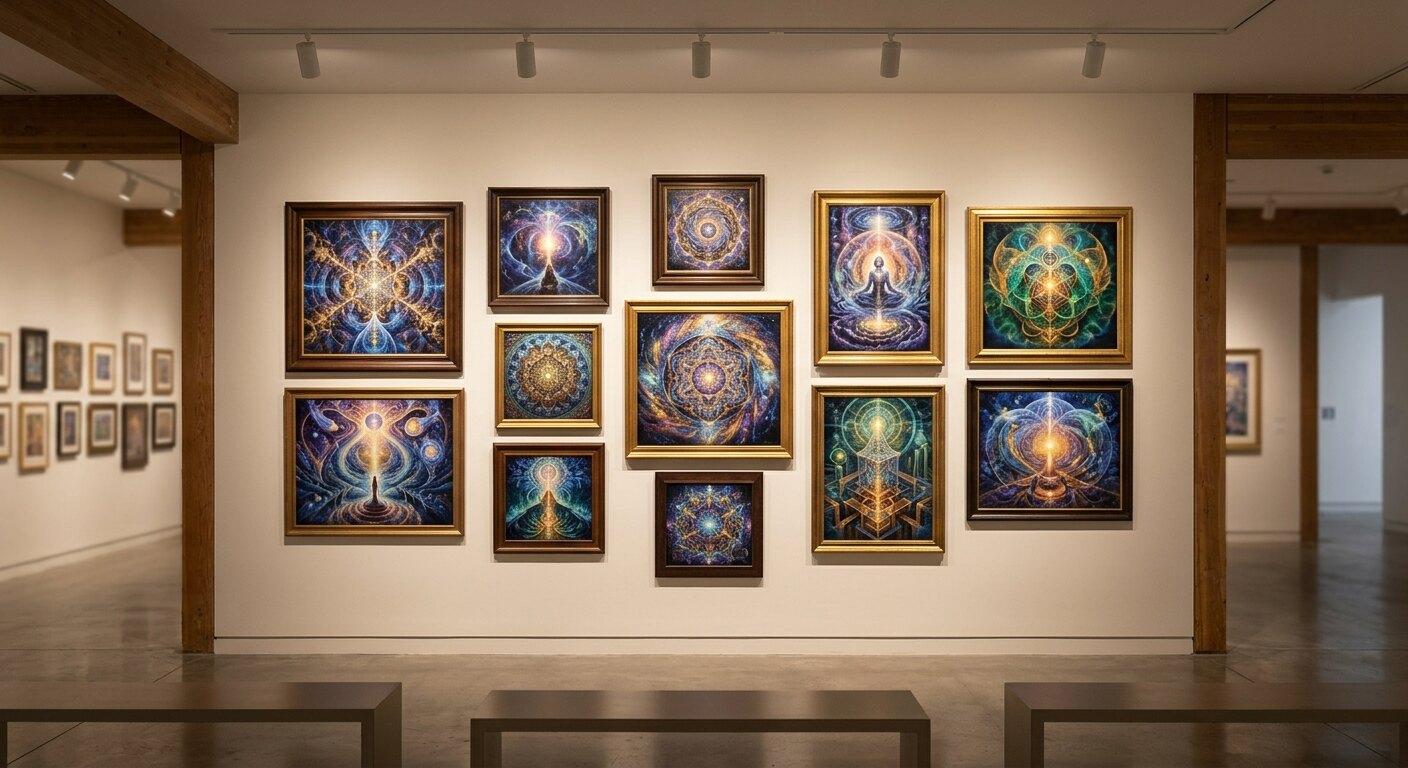
Looking at these works does not require any special preparation, yet a few practical habits help:
- Give the painting time. Many of the densest pieces reveal structure only after sustained looking.
- Notice both the overall composition and the smallest repeating motifs.
- Pay attention to how color relationships create movement or stillness.
- Allow emotional or associative responses without forcing an interpretation.
Reproductions in books or online are useful starting points, but scale and surface quality matter. Whenever possible, see major works in person or in high-quality large-format publications.
For official background on the cultural and scientific conversation around psychedelics, the Health Canada information on magic mushrooms and resources from established research centers provide grounded context. Art-historical overviews can be found through museum collections and scholarly writing on visionary and surrealist traditions.
For a deeper look at visionary art traditions, the official Alex Grey website offers extensive galleries and artist statements.
If you are also interested in the practical side of plant-based exploration, our Golden Teachers mushrooms page and related educational posts offer additional reading within a Canadian regulatory framework.
Practical Tips for Longer Looking Sessions
Some viewers find it helpful to sit with a single painting for ten or fifteen minutes without distraction. Others prefer to move slowly between several related works. There is no correct method. The most useful approach is simply the one that allows sustained, relaxed attention.
Final Thoughts
The best psychedelic artworks succeed when they make the invisible feel temporarily visible. Whether through Alex Grey’s energetic anatomies, Pablo Amaringo’s forest visions, Amanda Sage’s luminous portraits or Dalí’s optical complexity, these paintings expand the range of what visual art can attempt. They do not replace direct experience, nor do they require it. They simply offer carefully crafted invitations to look more carefully and to consider the mind’s capacity for novel forms of order and beauty.
Exploring this body of work is one accessible way to engage the same questions of perception, meaning and connection that have occupied artists and contemplatives for generations. The paintings remain available; the only requirement is attention.
Continuing the Exploration
The conversation around psychedelic art continues to evolve as new artists emerge and older works find fresh audiences. Whether you encounter these paintings in a gallery, a book, or online, each viewing offers another opportunity to notice how visual form can open unexpected perspectives.
Frequently Asked Questions
Q: What is psychedelic art?
A: Psychedelic art is visual work inspired by or intended to evoke altered states of consciousness. It often features intense color, fractal or geometric patterns, distorted space and imagery that suggests transformation or expanded awareness.
Q: Who are the most important psychedelic artists?
A: Widely cited figures include Alex Grey, Pablo Amaringo, Amanda Sage, Allyson Grey and, in a related surrealist register, Salvador Dalí. Each brings a distinct approach to depicting inner experience.
Q: Is Salvador Dalí considered a psychedelic artist?
A: Dalí is primarily classified as a surrealist. Certain late works, especially The Hallucinogenic Toreador, display optical and layered qualities that place them near the psychedelic tradition, even though Dalí claimed not to rely on external substances.
Q: What is the difference between visionary art and psychedelic art?
A: Visionary art is the broader category describing depictions of mystical or inner encounters. Psychedelic art is often used more specifically for work linked to experiences associated with psychedelic substances, though the two terms overlap heavily in practice.
Q: Do I need to have taken psychedelics to appreciate these paintings?
A: No. The strongest works function as complete visual experiences on their own. Prior personal experience may change how a viewer relates to the imagery, but it is not required for engagement or enjoyment.
Q: Where can I see major psychedelic artworks?
A: Originals appear in specialized galleries, private collections and occasional museum exhibitions. High-quality books and official artist sites remain the most reliable ways to study the major paintings in detail.
